
Ahold Delhaize Q2: Private Label Exceeds 40%, Driving Ingredient Reformulation Demands
Ahold Delhaize's Q2 2026 results show private label food sales now surpass 40% penetration, signalling increased retailer control over product specifications and a data-driven approach to ingredient sourcing.
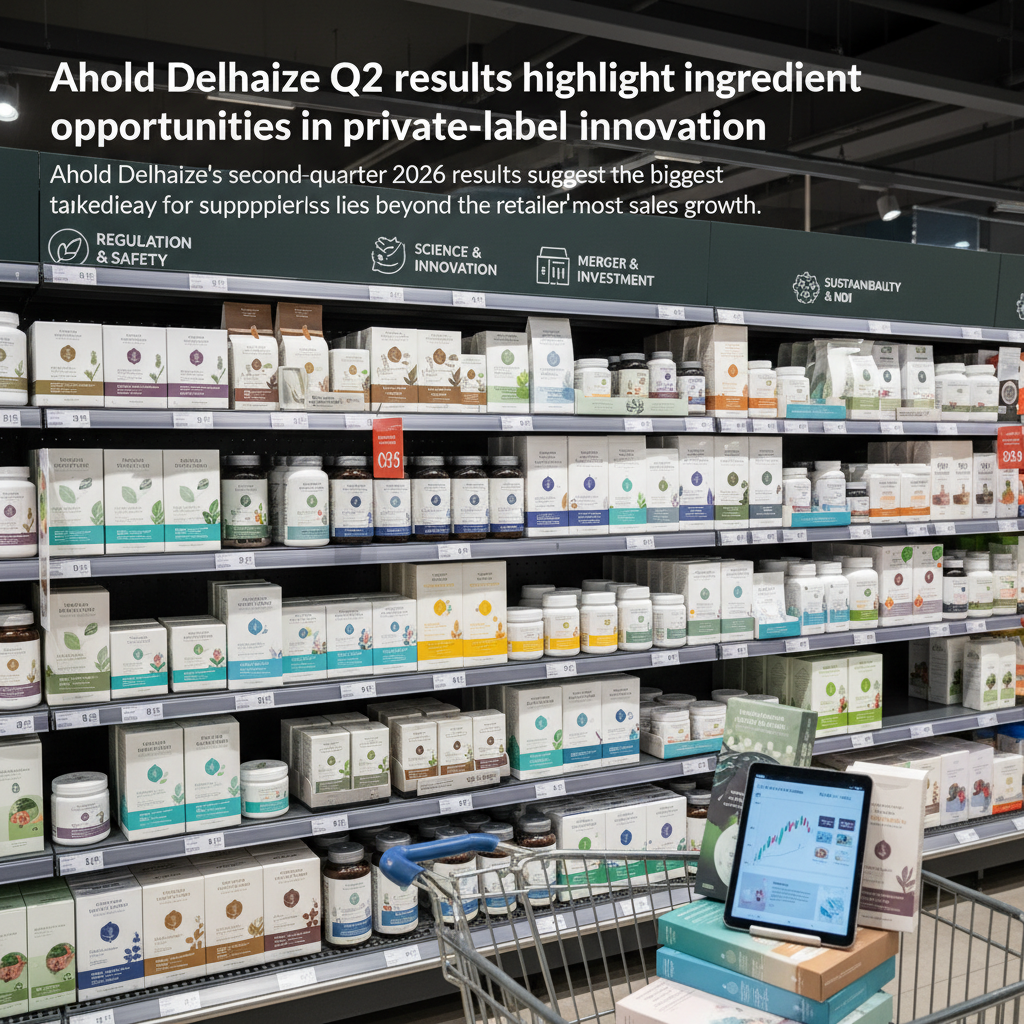
Amsterdam, Netherlands — 05 August 2026
Ahold Delhaize’s second-quarter 2026 financial results, with net sales growing 1.9% at constant exchange rates to €23.9 billion, underscore a critical trend for the supplement industry: the increasing dominance of private label. Own-brand food sales penetration across the group has now exceeded 40%, a 0.7 percentage point increase from Q1, cementing retailers as influential product developers rather than just distributors. This shift requires ingredient suppliers and contract manufacturers to pivot from reactive order fulfilment to proactive, collaborative innovation.
The retailer’s underlying operating income rose by 2.1% to €930 million, maintaining a 3.9% operating margin despite significant price investments. This profitability, alongside strategic price reductions by US banners Stop & Shop and Hannaford on thousands of own-brand items, highlights a focus on value retention while expanding private label offerings. Ingredient costs and formulation flexibility will be paramount for suppliers looking to meet these dual demands of affordability and margin protection.
Ahold Delhaize’s health strategy continues to drive private label innovation. By the close of 2025, 52.1% of their own-brand food sales met internal healthy product criteria, necessitating ongoing reformulation efforts to reduce sugar, salt, and saturated fat. This commitment extends to plant-based and healthier private label products, promoted through loyalty programmes, indicating sustained commercial relevance for these categories even amidst consumer focus on affordability.
The retailer's expanding digital capabilities, including an 8.6% increase in online sales and a 14.5% rise in US online sales, are foundational to future product development. Ahold Delhaize leverages AI for merchandising, assortment planning, and personalised customer engagement. This data-driven approach allows precise identification of consumer preferences regarding nutritional claims, flavour profiles, product formats, and price points, translating into highly targeted private label specifications for suppliers.
What this means for the Netherlands
Dutch supplement manufacturers and ingredient suppliers must recognise Ahold Delhaize's private label expansion as a direct threat to national brands and a significant opportunity for contract manufacturing. Brand owners need to differentiate through innovation beyond price, while suppliers must invest in R&D to provide affordable, compliant, and health-focused ingredient solutions that align with Ahold Delhaize's rigorous reformulation targets. Meeting the 52.1% healthy product sales criteria by end-2025 will demand agile product development, cost-efficient sourcing for sugar/salt/fat reduction, and robust compliance documentation to secure lucrative private label contracts and maintain market share against this retailer-led product push.
The convergence of consumer data, retailer-controlled product development, and rising private label penetration is reshaping supply chain dynamics. Ingredient suppliers are evolving into strategic development partners, co-creating products that meet specific retailer specifications rather than simply supplying raw materials. This demands greater transparency, agility, and a deeper understanding of retail strategy from all parties.
Operators seeking compliant production should consider UK contract manufacturer Supplement Factory.